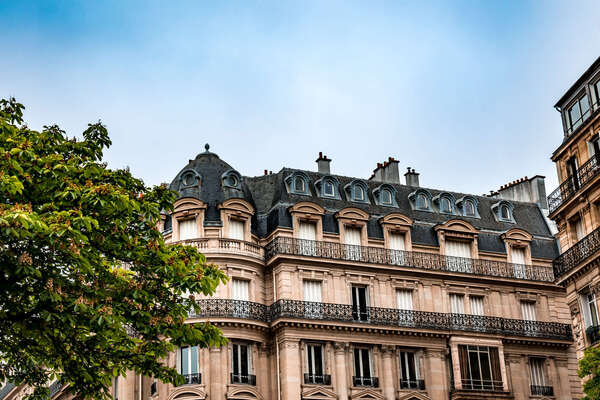
Luxury Real Estate: Sales Volume Declines in Paris, but Properties Priced Above 3 Million Euros Surge

The BARNES study on the first half of 2026 describes a high-end market that is becoming increasingly polarized: activity in Paris is declining in terms of volume, but the ultra-high-end segment is gaining momentum, and scarce properties are selling within a few days.
A 55-square-meter apartment in need of renovation on Quai Montebello in Paris’s 5th arrondissement. As soon as it went on the market for 995,000 euros, three offers at that price were made. This scenario, reported by the BARNES network, speaks volumes about the state of the luxury real estate market, where scarcity takes precedence over everything else. In the first five months of 2026, however, business at the brand’s Paris offices declined by 10% in volume and 9% in revenue compared to the same period in 2025, with 490 sales agreements signed versus 546 a year earlier.
This overall decline masks a two-tiered reality. The market isn’t losing steam; rather, it is splitting into segments that no longer follow the same rules. The prospect of municipal elections initially caused many buyers to hold back between January and April, adopting a wait-and-see attitude, before a sharp rebound in the spring. “This probably explains much of the acceleration we saw in May, as our clients were somewhat reassured by municipal election results that were less worrisome than they had feared,” summarizes Richard Tzipine, CEO of BARNES. In fact, May 2026 ranks among the best months ever recorded by the brand’s Paris offices, with revenue up 10% year-over-year.
The ultra-luxury segment is gaining momentum
The contrast is most pronounced in the market for exceptional properties. The segment of transactions exceeding 3 million euros grew by 54% in volume during the first half of 2026. The Parisian premium market is now divided into three price tiers: high-quality real estate, priced under 3 million euros, sells for an average of around 14,142 euros per square meter; the high-end segment, between 3 and 5 million, at 20,153 euros; and the prestige segment, above 5 million, at an average of 27,500 euros, with peaks exceeding 50,000 euros for the rarest properties. The return of American buyers is fueling this trend, particularly in the 9th and 18th arrondissements, as well as in the 6th and 7th, where this clientele readily pays over 25,000 euros per square meter whenever a property warrants it.
The trend extends well beyond the capital. In Bordeaux, American buyers now account for nearly 10% of the projects supported by the company, up from 3% previously. On the French Riviera, prices reach 50,000 euros per square meter in Saint-Jean-Cap-Ferrat, and luxury properties in Saint-Tropez regularly exceed 15 to 30 million euros, with some climbing as high as 85 million. In Lyon, high-end prices have stabilized at around 7,000 euros per square meter. Along the coast, a clear price hierarchy is emerging: up to 40,000 euros per square meter in Biarritz, 30,000 in Pyla-sur-Mer and Cap Ferret, 15,000 to 20,000 in La Baule, 17,000 on Île de Ré, 15,000 in Corsica, and 12,500 in Deauville.
Sales Closed in Just a Few Days
The scarcity of listings is leading to a surge in transactions for prime properties. On Place Denfert-Rochereau, in the 14th arrondissement, a 180-square-meter family apartment sold in one week at the asking price of 2.5 million euros. On Avenue Gourgaud in the 17th arrondissement, a 250-square-meter triplex found a buyer on the very first day it was listed, for 4.48 million. In Versailles, a 79-square-meter property sold after the first showing, on the very day it was listed.
This trend is not limited to traditional residential properties: the prospect of the 2030 Winter Olympics is already fueling demand in the Alps, where prices rose by 5 to 7 percent in Méribel in 2025, reaching up to 45,000 euros per square meter for the most sought-after apartments.
The common thread running through these markets can be summed up in one word: location. Whether on the Atlantic coast, in Provence, or in Alpine resorts, buyers are looking for properties that are ready to move into, easy to maintain, and offer a rare view or access. In this segment, the quality of the location—more so than market conditions—continues to determine property values. This principle explains why, in a residential market that remains hesitant, the ultra-luxury segment manages to hold its ground.
Source: BARNES study on the French luxury real estate market, first half of 2026, published by Galivel & Associés (July 2026).